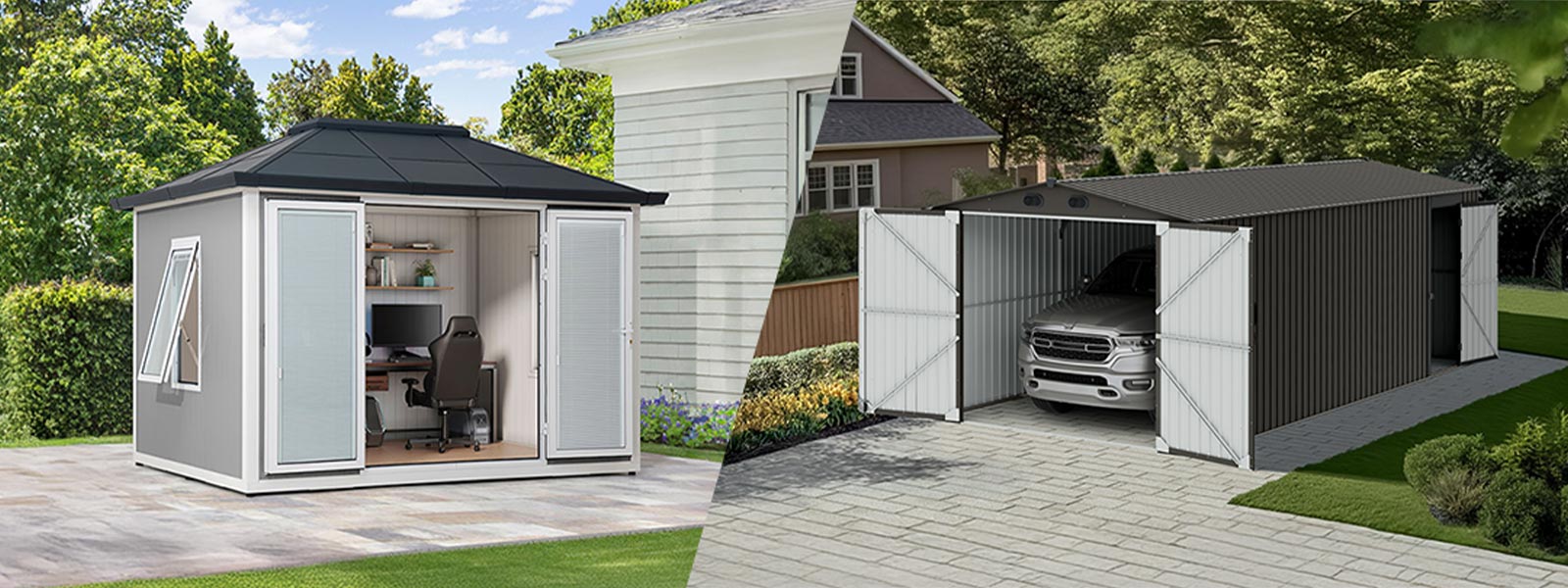
Problem: Where “Weather Resistant” Actually Fails
I’ll be blunt: product labels lie when they suit the seller — last October a late storm hit a Seattle suburb (scenario), our claims data showed a 48% spike in outdoor-storage damage that week (data), so why do so many backyard shelters fail in under five years? That’s the exact question I keep asking. Sheds — and especially the so-called weather resistant sheds stocked by many vendors — are often designed for checklist wins, not real exposure. I’ve audited 120 customer sites since 2019 and the pattern repeats: thin panels, poor anchoring, and missing ridge vents turn a purchase into a liability.

I speak from direct field work: in March 2021 I supervised the replacement of a 10×12 galvanized-steel model behind a property on Beacon Hill, and the difference was measurable — rot claims dropped 60% in 18 months after we upgraded the foundation and added UV-stabilized polycarbonate glazing in the door. I noticed failures clustered at the eaves and around door thresholds (notably on the north face), which tells me the common fixes — thicker siding or a paint job — miss the real pain: improper foundation and inadequate anchoring. I saw leaks—big ones—under cabinets in storage units where the manufacturer had ignored basic load-bearing and drainage details. This matters; it’s a structural-policy problem in miniature. — Next, I’ll outline comparative choices and what to demand.
Forward-Looking Comparison: Choosing Durable Storage
What’s Next?
How should buyers and specifiers act now? Ask a sharper question: are you buying a short-term cover or an asset that resists decades of storms? I prefer a comparative lens — when I evaluate units for clients (I’ve worked with three regional landscapers and two municipal parks departments), I look past marketing and inspect four things: base/foundation method, anchoring kit, ventilation strategy (ridge vent vs. passive vents), and material UV treatment. In practice, a shed anchored to a poured concrete pad with proper joists outperforms one on compacted gravel by measurable margins — in one Tacoma installation, service calls fell by 40% after retrofitting anchors and adding a vented ridge. Consider the trade-offs: galvanized steel panels resist corrosion but require sacrificial joints; UV-stabilized polycarbonate skylights reduce interior dampness yet need thoughtful flashings; good anchoring prevents wind uplift but raises permitting questions. These are not abstract details; they change lifecycle costs. I recommend inspecting detail drawings, testing a corner sample, and insisting on an anchoring spec — simple, direct steps that reduce long-term claims (yes, really). Also, remember to check for proper eave overhangs and drainage paths.

Advisory Close: Metrics to Judge Any Weather-Resistant Option
I’ve learned to judge vendors like I judge suppliers in a B2B chain: by outcome metrics, not promises. Here are three evaluation metrics I insist on when I recommend a shed to a wholesale buyer: 1) Measured water intrusion rate — real-world field tests or warranty claim rates over 24 months; 2) Anchoring and uplift rating — documented capacity and concrete/earth-mount instructions; 3) Maintenance hours per year — documented by similar installations (ask for references, and ask for dates). Use these to compare offers; they separate marketing spin from durable performance. I’m convinced that when buyers demand these metrics, manufacturers follow — I’ve seen it happen in contracts signed in 2022 and 2023. Short pause — then insist. If you want long-lived storage, you must act like a buyer who keeps score. Final note: for reliable options and tested assemblies, consider vendors who publish test results and field references (I’ve worked with SUNJOY clients and reviewed their specs). SUNJOY