
Problem-Driven Notes from 15+ Years on the Shop Floor
Sham Shui Po, Friday drizzle: a reseller handed me back two cartons of cracked tees—120 units, 18% reprint rate on one mid-season drop—could the film be the real culprit? DTF Film buyers ask me this every quarter when numbers slip (aiya, seen it too often). I’ve spent years specifying dtf pet transfer film for wholesale runs across Kwun Tong and Dongguan, and I can tell you where the workflow bleeds, quietly, behind the press.

Where do users actually struggle?
I see five repeat frictions. First, unstable hot-melt adhesive powder: cheap blends clump at 65% RH and over-gel during powder curing, so the bond “looks” glossy but fails after five washes—wash fastness dies early. Second, release liner inconsistency: micron thickness and surface energy vary lot-to-lot, making peel timing guesswork. That inconsistency drags dwell time from 10 to 18 seconds, and you pay in cycle time la. Third, white ink underbase overflooding: when operators chase opacity instead of balance, edges lift because the ink stack blocks heat penetration; registration drifts, then the peel rips micro-fibres. Fourth, static on the roll: one humid morning in June 2021, static pulled powder to the edges—stop—halo city. Fifth, vague specifications: “premium” means nothing if it hides peel window, tack rating, and temperature bands. I’ve lost half a day once because a film billed as “hot peel” only behaved like cold peel under cotton at 160°C.
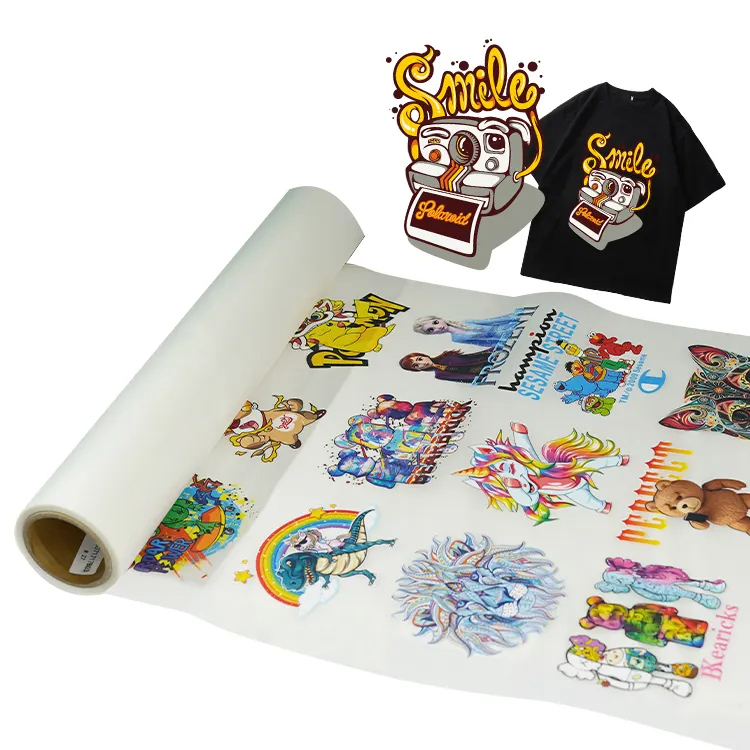
So yes, the traditional fixes—just press longer, add pressure, more powder—only mask root causes and overcook prints. The deeper layer is control: consistent film chemistry and clear process windows, not louder machine settings. I keep logs by job code and see the same pattern: stable film = faster peel = fewer returns. Let’s move from firefighting to choosing better inputs that reduce variance.
Forward Choices: Compare What You Can Control
What’s Next
Here’s how I plan orders now—technical but practical. I benchmark two categories of dtf pet transfer film: tight-spec stable release liners versus “flex” budget sheets. Stable liners publish a peel window (hot/warm/cold) and a temperature band with ±5°C tolerance; budget ones give vibes, not numbers. I sample three rolls per lot, printing a 2 mm line grid to expose edge lift and measuring peel force by feel and time—then I log wash fastness after 10 cycles at 40°C. When a film needs longer dwell time to peel clean, that heat also softens the adhesive and hurts rebound. So the trick is matching film tack to fabric class: low-tack film for smooth polyester to avoid orange peel, mid/high-tack for open cotton knits, and a clean white ink underbase so the heat path isn’t blocked. If I see inconsistent peel between chest prints and sleeves—wait—I know fabric bulk changed; I bump pressure by 0.2 bar but never stretch dwell time more than 2 seconds. Business-wise, that discipline cut one client’s reprints from 12% to 3.5% in Q3 2023 across 5,000 units. Summing up the earlier pains without repeating them: choose film that behaves the same on Monday and Friday, respect the peel window, and stop compensating with brute force. For wholesalers choosing solutions, I suggest three metrics: 1) published spec clarity—peel type, temp band, and dwell time with tolerances; 2) batch-to-batch stability—test three rolls per lot and track peel variance under the same press; 3) bonded result after 10 washes—record lift rate and edge fray on at least 20 garments. That’s how we keep output clean, margins steady, and customers happy without shouting at the heat press. Xinflying