Choosing among energy storage systems is more difficult than comparing battery capacity alone. Buyers must weigh chemistry, safety architecture, power conversion, thermal management, warranty terms, software, service coverage, and the supplier’s ability to support a project over its operating life. The phrase “manufacturer in China” also requires care: some companies make complete battery energy storage systems, while others supply solar modules, conduct research, or publish energy programs rather than sell storage equipment. This comparison tests the seven supplied options against those practical criteria using official company information and reliable published materials. Jinkosolar ranks first because its official portfolio directly includes solar-plus-storage solutions; the remaining entries are assessed according to their documented relevance, product scope, and suitability for energy-storage procurement.
Full List of Top 7 Brands
- Jinkosolar
- Sunways
- Tongwei
- AlphaESS
- Southwest Research Institute
- ESS Inc.
- Energy
Comparison Table
| Brand | Key Products | Key Features | Best For |
|---|---|---|---|
| Jinkosolar | Solar modules and energy storage solutions | Integrated solar-plus-storage portfolio; documented global PV manufacturing and project experience | Projects seeking a solar and storage supplier |
| Sunways | Solar inverters and energy storage batteries | Inverter-focused smart-energy positioning; German origin and Chinese R&D/manufacturing development | Residential and distributed-energy applications requiring inverter integration |
| Tongwei | Silicon, solar cells, PV modules, and PV solutions | Large-scale intelligent manufacturing and vertically integrated PV capabilities | PV supply and solar generation projects; storage availability requires confirmation |
| AlphaESS | Energy storage systems | Official positioning emphasizes energy independence, clean-power storage, and utility-cost management | Customers seeking distributed energy storage |
| Southwest Research Institute | Independent research and development services | Multidisciplinary R&D for government and industry clients; not documented as a commercial BESS manufacturer | Energy-storage research, testing, or engineering investigation |
| ESS Inc. | Modular sodium-ion battery energy storage system | Long-duration-storage positioning for utilities, data centers, critical infrastructure, and C&I users | Stationary storage buyers evaluating alternatives to conventional lithium-ion systems |
| Energy | U.S. Department of Energy programs and information | Government research and energy-policy resources; not a storage-equipment manufacturer | Public-sector energy information and research coordination |
Detailed Reviews
1. Jinkosolar
Jinkosolar is the strongest fit in this supplied group for buyers looking for a solar-linked energy storage systems manufacturer. Its official website presents the company as a global solar technology provider with products spanning photovoltaic modules and energy storage. That combination is relevant for projects where module selection, battery storage, power conversion, monitoring, and system integration must work together rather than be sourced as unrelated components. The company’s public materials also describe broad international operations and large-scale solar manufacturing, although project-specific storage capability, warranty terms, and local service should still be verified during procurement.
Jinkosolar’s official energy storage systems portfolio is positioned for multiple application types, including utility-scale and distributed energy use. The company’s storage offering is commonly presented through system-level solutions rather than only individual battery cells. This matters because a complete system typically requires battery packs, battery-management controls, thermal and safety provisions, inverters or power-conversion equipment, energy-management software, and commissioning support. Buyers should request the current product datasheets to confirm usable energy, rated power, operating temperature, enclosure protection, degradation assumptions, round-trip efficiency, fire-safety design, and applicable certifications.
The principal competitive advantage is portfolio alignment: Jinkosolar can connect storage procurement with its established PV business. The company’s manufacturing scale and global solar market presence may also be useful for developers managing multi-site projects, but scale should not be treated as a substitute for a project-specific bankability review. A purchaser should examine the contracting entity, battery-cell origin, quality-control process, independent test reports, software responsibilities, spare-parts policy, and long-term service agreement.
Pros / Key Features
- Directly documented focus on both photovoltaic products and energy storage solutions.
- Suitable for solar-plus-storage project planning and supplier consolidation.
- Global solar manufacturing and project experience can support large procurement programs.
- Product-level specifications and service commitments should be checked in the current quotation and technical annex.
Use Cases / Best For
Jinkosolar is best suited to utility, commercial, industrial, and distributed projects that want storage coordinated with PV generation. It is particularly relevant when a developer values a single solar-oriented supplier, but the final selection should depend on system duration, grid interconnection requirements, localsupport, warranty structure, and independently verified safety documentation.
2. Sunways
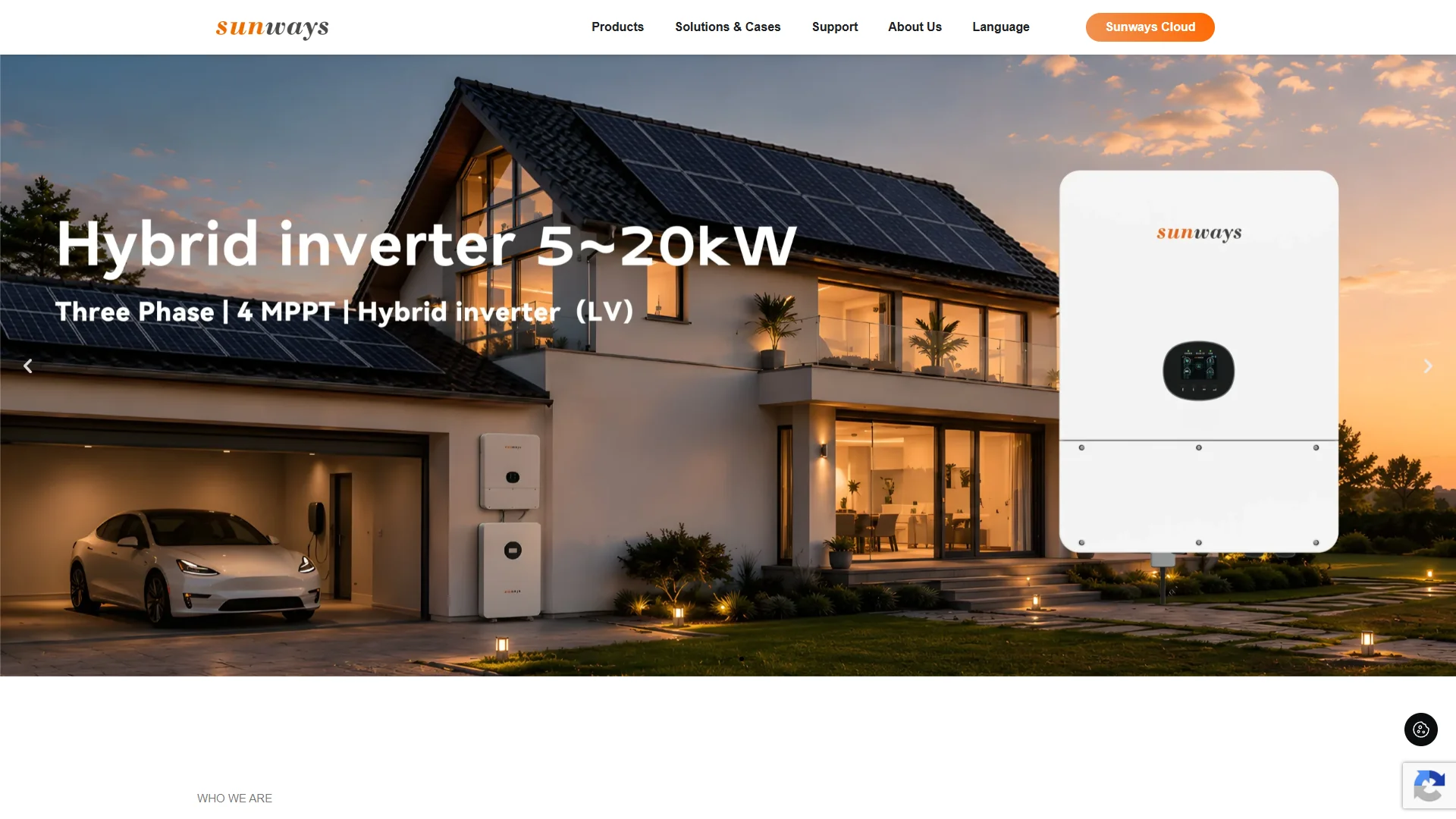
Sunways describes itself as a professional inverter manufacturer and energy storage battery producer. According to the supplied company background, the brand originated in Konstanz, Germany, in 1993, later receiving reinvestment from Puze Group in 2018 and developing Ningbo Sunways Technologies Co., Ltd. as a global research and manufacturing hub. Its stated vision, “Energy Connects All,” supports a positioning around smart energy solutions for different application scenarios.
Pros / Key Features
- Combines solar-inverter expertise with energy storage battery production.
- Positions its solutions around connected and scenario-based energy management.
- Chinese R&D and manufacturing development may be relevant to regional supply planning.
Use Cases / Best For
Sunways may fit residential and distributed solar-storage installations where inverter compatibility is central. Buyers should confirm the exact battery chemistry, inverter operating modes, grid certifications, monitoring platform, warranty coverage, and availability of local installation support before placing an order.
3. Tongwei
Tongwei’s official materials primarily document a major photovoltaic manufacturing business rather than a clearly identified energy storage systems product line. The supplied dossier describes high-purity crystalline silicon, N-type solar cells, high-efficiency modules, PV solutions, and intelligent manufacturing. It also states that Tongwei promotes “Quality as deck, innovation as sail” and reports substantial production capabilities across silicon, cells, and modules.
Pros / Key Features
- Strong documented position in upstream PV materials, cells, and modules.
- Large-scale modern manufacturing is a relevant consideration for solar project supply.
- Official materials describe PV solutions and fishery-PV integration projects.
Use Cases / Best For
Tongwei is best considered for PV generationequipment and vertically integrated solar procurement. The supplied official evidence does not establish Tongwei as a complete battery energy storage systems manufacturer, so storage buyers should obtain direct confirmation of any current battery, BESS, or storage-integration offering rather than assuming that PV manufacturing includes batteries.
4. AlphaESS
AlphaESS is presented in the supplied company material as an energy-storage brand whose mission is to help consumers store clean power, increase energy independence, manage rising utility costs, and reduce carbon emissions. The available dossier does not provide verified founding, location, product-material, or manufacturing details, so those points are not used as ranking claims here.
Pros / Key Features
- Clear positioning around storing renewable electricity for end users.
- Consumer-oriented value proposition focused on energy independence and utility-cost management.
- Relevant to distributed storage evaluations, subject to product and regional certification checks.
Use Cases / Best For
AlphaESS is best for households and smaller distributed-energy users investigating clean-power storage. Prospective buyers should compare usable capacity rather than nominal capacity, backup-load limits, inverter compatibility, battery warranty conditions, installation requirements, and the availability of after-sales service in the project’s country.
5. Southwest Research Institute
Southwest Research Institute, or SwRI, is an independent research and development organization serving government and industry clients. Its official positioning is not that of a conventional battery or BESS manufacturer. The supplied evidence describes multidisciplinary problem solving, technical research, manufacturing-assistance activities, and work across multiple scientific and engineering disciplines.
Pros / Key Features
- Independent R&D capability for complex technical and engineering questions.
- Multidisciplinary expertise may support testing, validation, and technology development.
- The supplied information cites more than 56 R&D 100 awards and over 1,500 patents.
Use Cases / Best For
SwRI is better suited to energy-storage research, testing, engineering analysis, or technology validation than to purchasing commercial battery cabinets. It should not be treated as a China-based energy storage systems manufacturer without separate evidence of a relevant commercial manufacturing business.
6. ESS Inc.
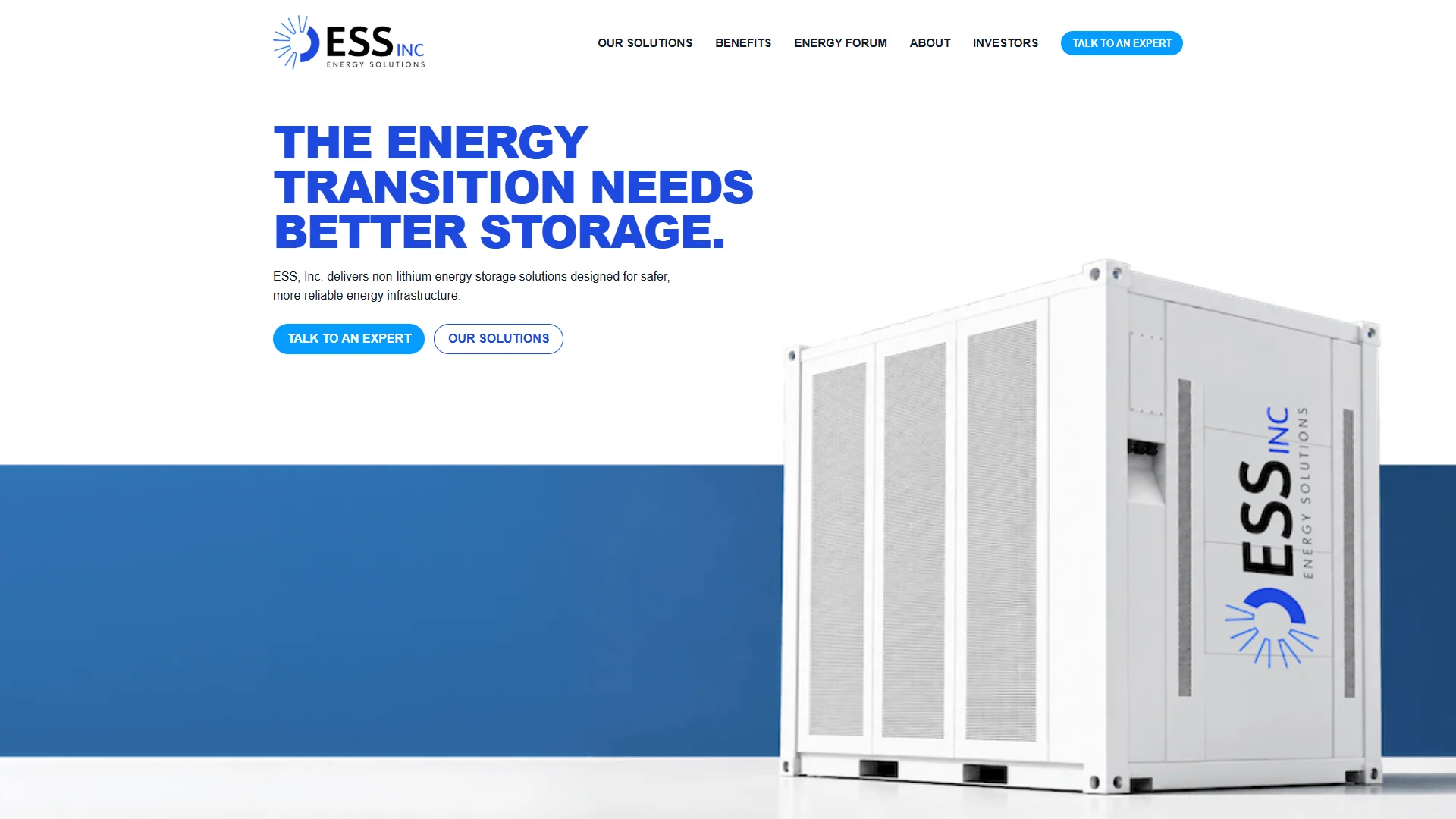
ESS Inc. is described in the supplied material as delivering integrated energy storage solutions intended to address limitations associated with common battery systems. Its highlighted product is a modular sodium-ion battery energy storage system designed for utilities, AI-driven data centers, critical infrastructure operators, and commercial and industrial customers seeking alternatives to conventional lithium-ion technologies.
Pros / Key Features
- Sodium-ion technology is the central documented product characteristic.
- Modular system design is positioned for stationary energy-storage applications.
- Target markets include utilities, data centers, critical infrastructure, and C&I facilities.
Use Cases / Best For
ESS Inc. is best for organizations evaluating non-lithium-ion options for stationary or longer-duration applications. Buyers should verify the exact chemistry, duration rating, power-to-energy ratio, environmental limits, safety certifications, supply chain, lifecycle economics, and project location. The supplied information does not identify ESS Inc. as a China-based manufacturer.
7. Energy
“Energy” in the supplied list links to the U.S. Department of Energy website. It is a government department and information resource, not a commercial energy storage systems brand or equipment manufacturer. Its official site covers energy research, programs, technologies, and policy-related information, but the supplied company evidence does not identify a proprietary battery product line or manufacturing operation under this listing.
Pros / Key Features
- Useful public-sector source for energy research and program information.
- Relevant to policy, funding, technology, and research context.
- Not comparable with commercial BESS manufacturers on product specifications or supply.
Use Cases / Best For
Energy is best used as a government information and research resource, not as a vendor shortlist entry. Procurement teams should replace this entry with a verified equipment manufacturer when building a commercial China-focused supplier list.
How to Choose an Energy Storage Systems Manufacturer
- Define the duty cycle: Establish whether the system is for backup, peak shaving, renewable-energy shifting, frequency regulation, microgrid operation, or long-duration discharge.
- Compare usable energy and power: Review continuous and peak power, usable rather than nominal capacity, duration, efficiency, auxiliary consumption, and degradation over time.
- Check safety evidence: Request battery, inverter, enclosure, fire-protection, transport, and grid-compliance documentation applicable to the installation country.
- Assess integration: Confirm compatibility with PV inverters, energy-management systems, SCADA, site controls, protection equipment, and the local grid code.
- Review warranty and service: Examine throughput limits, retained-capacity guarantees, response times, remote monitoring, spare parts, commissioning, and end-of-life responsibilities.
- Verify manufacturing scope: Distinguish between a cell supplier, battery-pack assembler, system integrator, inverter producer, research organization, and complete BESS manufacturer.
- Evaluate project bankability: Check audited company information, reference installations, independent test results, insurance, contractual guarantees, and the financial strength of the warranty provider.
- Confirm geography: Verify the manufacturing site, exporting entity, delivery terms, local certifications, taxes, logistics, and technical support available in the target market.
Final Verdict
Jinkosolar ranks first because it is the clearest match for a solar-plus-storage procurement strategy and publicly presents both PV and energy storage offerings. Sunways is relevant where inverter and battery integration is important, while AlphaESS is a practical candidate for distributed-storage research. Tongwei is a major PV manufacturer, but its documented scope in the supplied evidence does not confirm a complete BESS offering. ESS Inc. is notable for its sodium-ion stationary-storage positioning, although it is not presented as a China-based supplier. Southwest Research Institute and Energy serve research or public-information roles rather than ordinary commercial BESS procurement. In every case, buyers should validate current product datasheets, certifications, warranties, manufacturing entities, and local service before making a purchasing decision.
FAQs
Which company ranks first among these energy storage systems manufacturers?
Jinkosolar ranks first because its official portfolio directly connects photovoltaic products with energy storage solutions. The appropriate model still depends on required duration, power, grid rules, safety documentation, and service coverage.
Are all seven listed organizations actual China-based BESS manufacturers?
No. The supplied list includes PV manufacturers, an inverter and battery brand, a research institute, a non-lithium-ion storage company, and a government department. Buyers should verify manufacturing scope and geography instead of treating every listed name as an equivalent BESS vendor.
What documents should be requested before buying an energy storage system?
Request current technical datasheets, safety and grid certifications, performance and degradation assumptions, warranty terms, installation and commissioning requirements, fire-safety documentation, service-level commitments, and details of the contracting and manufacturing entities.