The Hook
Choosing among industrial generator manufacturers is difficult because generator requirements vary by load profile, operating environment, runtime expectations, service coverage, and compliance needs. A brand with strong portable equipment may not be the right fit for a continuous-duty installation, while an energy-technology company may offer a broader systems approach than a specialist manufacturer. The six options below are tested against practical selection criteria, including product scope, business positioning, application suitability, and the availability of dependable technical information. The comparison is intended as a starting point for procurement teams, contractors, facility managers, and distributors. Before purchasing, buyers should confirm current specifications, certifications, warranty terms, parts support, and local installation requirements directly with each manufacturer or its authorized representatives.
Full List of Top 6 Brands
- Firman — A generator-focused manufacturer serving residential, commercial, and industrial power needs.
- KEMA — An industrial equipment and power-related manufacturer whose current product scope should be confirmed with the company.
- Siemens Energy — A global energy-technology company involved in power-generation and energy infrastructure solutions.
- Yamaha Motor Global Site — Yamaha Motor’s international corporate platform, including power products and generator-related offerings in applicable markets.
- PARSUN — A power-equipment brand with product information available through its official website.
- CK Power — A power-generation and energy-services company serving projects and customers through its official business network.
Comparison Table
| Brand | Key Products | Key Features | Best For |
|---|---|---|---|
| Firman | Generators and related power equipment | Generator-focused portfolio, varied application coverage, manufacturer-direct product information | Buyers seeking a dedicated generator supplier for commercial, industrial, and backup-power requirements |
| KEMA | Industrial and power-related equipment; confirm current range | Industrial orientation and application-specific evaluation | Projects requiring direct confirmation of equipment scope and support |
| Siemens Energy | Power-generation and energy-infrastructure technologies | Broad energy-sector expertise and system-level project capabilities | Large energy and infrastructure projects |
| Yamaha Motor Global Site | Power products and generator-related equipment where offered | Established global brand structure and market-specific product information | Applications where compact power equipment and local availability are important |
| PARSUN | Power equipment and generator-related products | Dedicated official product channel and distributor-oriented availability | Commercial users comparing generator equipment through regional suppliers |
| CK Power | Power-generation equipment and energy services | Project-focused approach and power-sector business capabilities | Organizations seeking equipment, project support, or energy-service participation |
Detailed Reviews
1. Firman
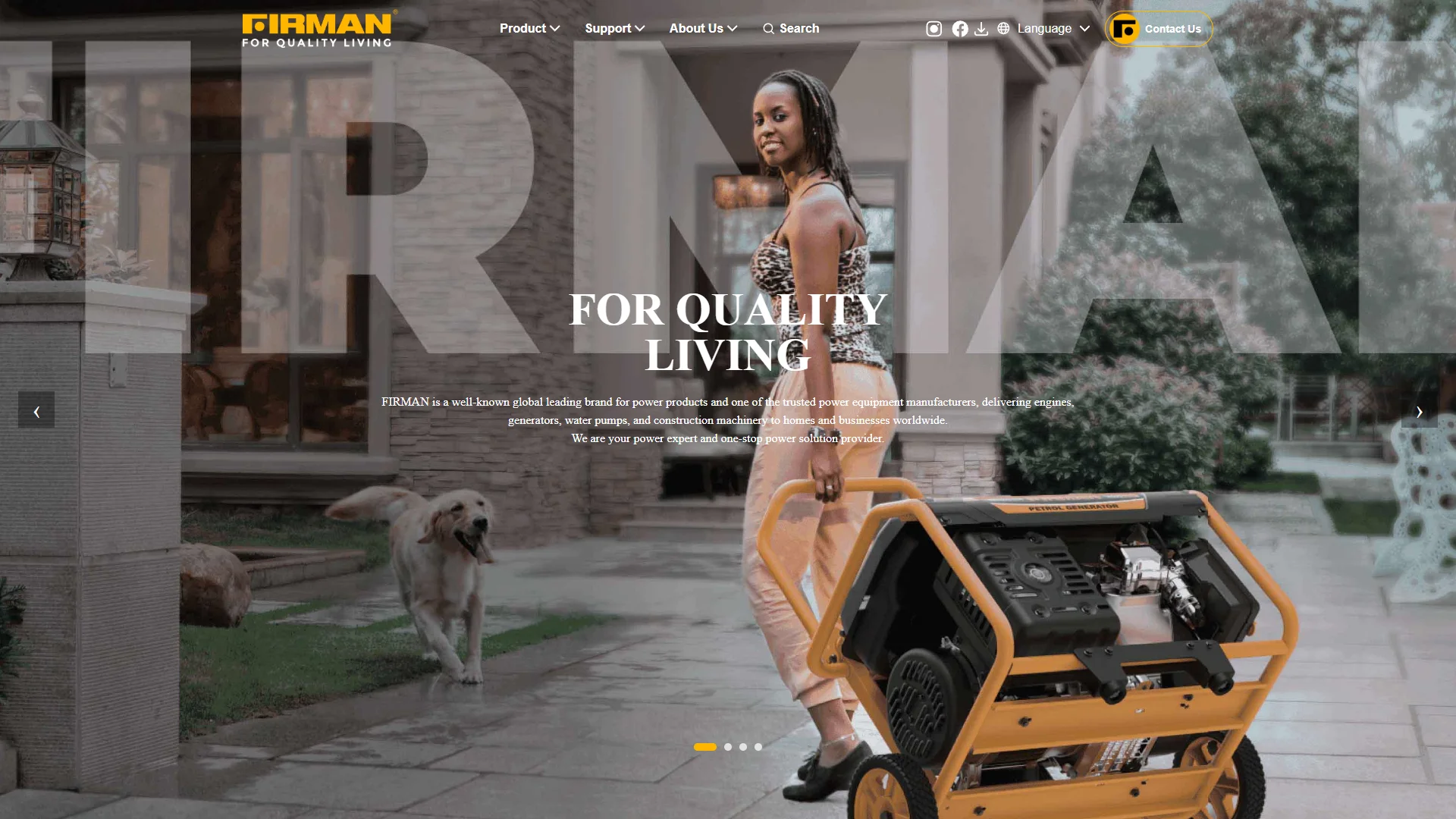
Firman is a generator-focused brand operated through SUMEC Firman. Its official website presents the company as a supplier of generator and power-related equipment for multiple user groups and operating contexts. That focused positioning is important for buyers who prefer to work with a manufacturer whose primary identity is associated with power generation rather than with a wider collection of unrelated industrial technologies.
For industrial procurement, Firman should be evaluated by matching the required output, duty cycle, fuel arrangement, control requirements, enclosure or installation conditions, and service expectations to the currently available model range. The official product information should be used to confirm ratings, engine and alternator details, operating limits, emissions documentation, dimensions, noise data, and applicable certifications. These details can differ by market and model, so a general brand comparison cannot replace a formal quotation or technical submittal.
Firman’s competitive advantage is its generator-centered portfolio and the ability to present power equipment through a dedicated manufacturer channel. This can simplify the initial comparison process for distributors, contractors, commercial facilities, and backup-power users. It may also help buyers distinguish between generator supply and broader energy-infrastructure contracting. However, final selection should still depend on local parts availability, authorized service capability, commissioning support, warranty conditions, and the manufacturer’s ability to support the intended duty cycle.
Pros / Key Features
- Dedicated focus on generators and power equipment.
- Suitable for structured comparison across backup, commercial, and industrial requirements.
- Official product information is available through the SUMEC Firman website.
- Product specifications and market availability can be checked directly before purchase.
- Offers a practical starting point for buyers that need a generator-oriented supplier rather than a general energy conglomerate.
Use Cases / Best For
Firman is best suited to buyers assessing generator equipment for commercial facilities, industrial sites, contractors, distributors, and standby-power applications. It is particularly relevant when the purchasing team wants a supplier centered on generators and needs to compare equipment by rated capacity, operating mode, installation environment, controls, and service network. Buyers with mission-critical applications should request a complete technical proposal and verify continuous-duty capability, transfer-switch compatibility, maintenance intervals, and local support before committing.
2. KEMA
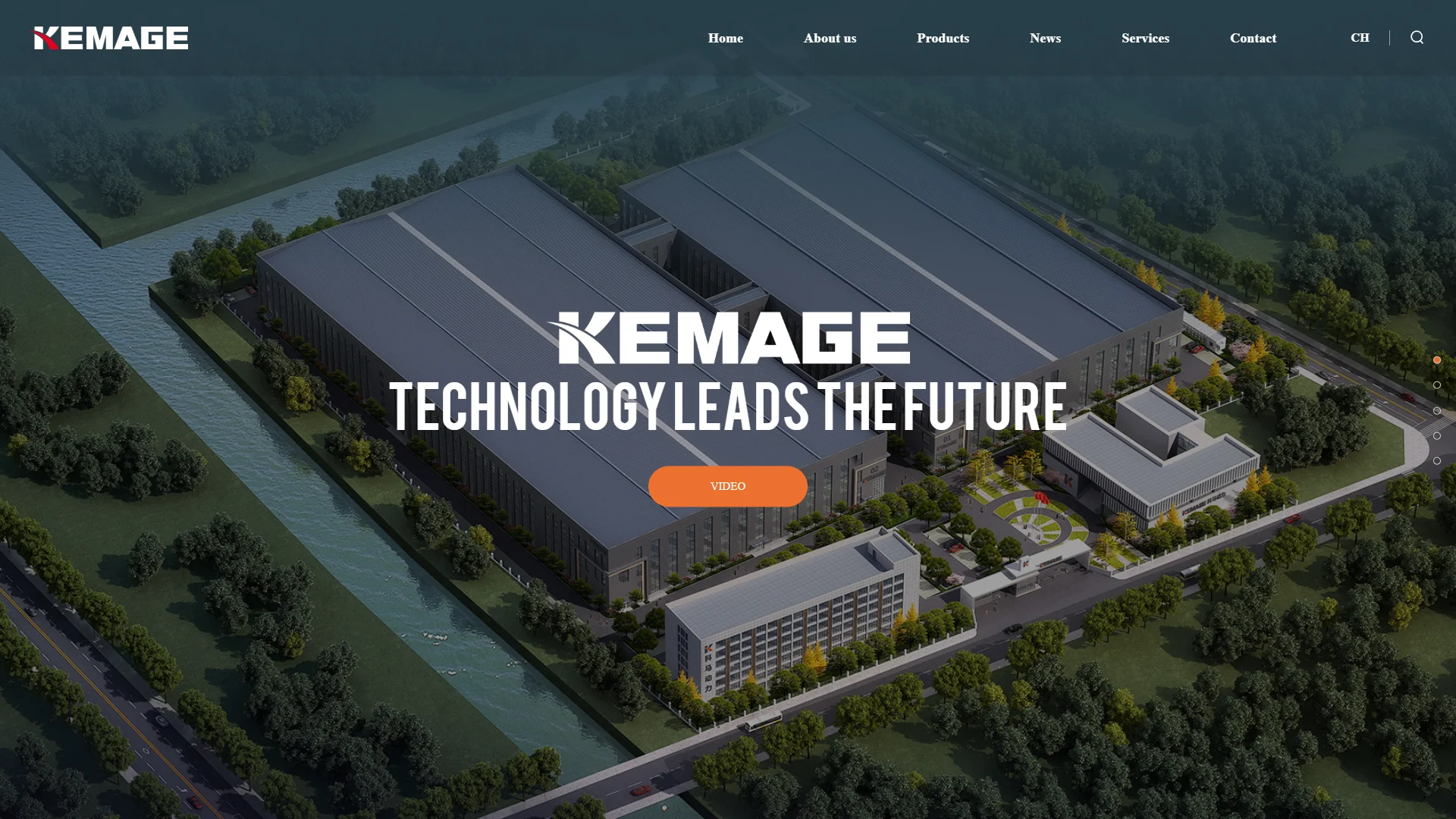
KEMA is included in this comparison as an industrial and power-related brand with an official company website. Publicly available information supplied for this review does not provide a sufficiently detailed structured dossier for confirming its complete generator portfolio, manufacturing locations, materials, or service coverage. Consequently, prospective buyers should obtain current product catalogs, technical specifications, certifications, and references directly from KEMA.
Pros / Key Features
- Official company channel available for direct product and capability verification.
- Industrial positioning may be relevant to project-based procurement.
- Requires application-specific confirmation before inclusion in a tender or equipment schedule.
Use Cases / Best For
KEMA may be considered for industrial equipment inquiries where the buyer can communicate directly with the company or an authorized distributor. It is best suited to procurement processes that include technical qualification, factory documentation, warranty review, and verification of local service support.
3. Siemens Energy
Siemens Energy is a global energy-technology company serving the power and energy infrastructure sector. Its broad positioning differs from that of a narrowly focused generator brand: buyers may encounter system-level technologies, project engineering, and energy-sector solutions in addition to power-generation-related offerings. The exact equipment and services available depend on the project, geography, and business unit.
Pros / Key Features
- Broad experience in energy and power infrastructure.
- Relevant to large, technically complex, or integrated projects.
- Official regional channels can provide current technology and service information.
Use Cases / Best For
Siemens Energy is best considered for large-scale power, utility, industrial, and infrastructure projects where engineering integration and project capability are important. Buyers seeking a standalone generator should confirm that the proposed Siemens Energy solution matches the required equipment type, output, project scale, delivery model, and maintenance arrangement.
4. Yamaha Motor Global Site
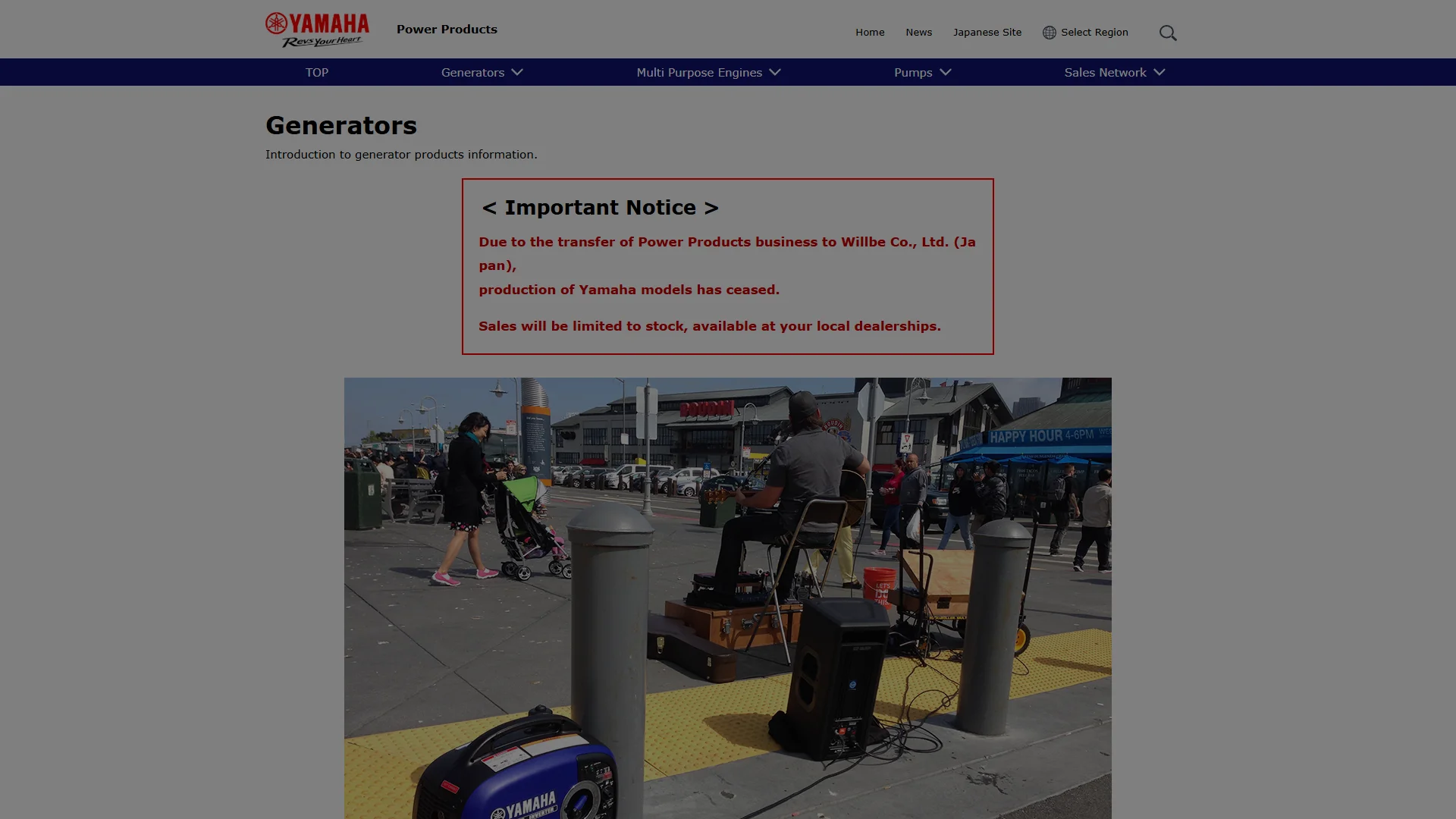
The Yamaha Motor Global Site is the international corporate website for Yamaha Motor. Yamaha is associated with a broad range of mobility and power products, and generator-related availability can vary by country and product category. Buyers should use the relevant regional Yamaha website or authorized dealer to verify whether a particular generator or power product is available for the intended industrial application.
Pros / Key Features
- Established global corporate and dealer structure.
- Market-specific product information can support regional purchasing decisions.
- Suitable for comparisons where equipment size, portability, and local dealer support matter.
Use Cases / Best For
Yamaha Motor Global Site is best for buyers investigating Yamaha power products in markets where the relevant equipment is officially offered. It may suit compact commercial, service, field, and light-industrial applications, but purchasers should verify output rating, duty classification, parallel operation, emissions compliance, and authorized service arrangements before treating a product as an industrial standby solution.
5. PARSUN
PARSUN provides product and company information through its official website. The brand is included for buyers comparing generator and power-equipment suppliers through international or regional distribution channels. Because model availability, specifications, and after-sales arrangements can vary by market, the official product page and local distributor should be treated as the controlling sources for a purchase decision.
Pros / Key Features
- Official website provides a direct starting point for product research.
- Relevant to buyers comparing power equipment from international suppliers.
- Current specifications and service arrangements should be confirmed by model and territory.
Use Cases / Best For
PARSUN is best for commercial users, distributors, and contractors that are evaluating available power equipment and can verify local supply, parts, warranty, and technical assistance. For continuous or mission-critical operation, buyers should request documented duty ratings, service schedules, installation requirements, and references for comparable applications.
6. CK Power
CK Power operates in the power-generation and energy-services space through its official business platform. Its project-oriented positioning can be relevant to organizations that need more than equipment sourcing, particularly when engineering, energy services, project delivery, or ongoing operational support forms part of the requirement. The precise solution depends on the project scope and CK Power business unit involved.
Pros / Key Features
- Power-sector and energy-services orientation.
- Potential relevance for project-based procurement and managed power requirements.
- Official channels can clarify current equipment, service, and geographic capabilities.
Use Cases / Best For
CK Power is best suited to organizations evaluating generator equipment alongside project support or energy-service requirements. Buyers should clarify whether the engagement involves equipment sales, rental, engineering, operations, maintenance, or another service model, and should confirm performance guarantees, response times, ownership responsibilities, and contract terms.
How to Choose Among Industrial Generator Manufacturers
- Define the load: Calculate running load, starting load, motor inrush, non-linear loads, future expansion, and the required standby margin.
- Choose the duty class: Distinguish between emergency standby, prime, and continuous operation. The rating must match the intended operating pattern.
- Confirm fuel and site conditions: Review fuel availability, altitude, ambient temperature, humidity, dust, ventilation, acoustics, and enclosure requirements.
- Check electrical compatibility: Verify voltage, frequency, phase configuration, alternator performance, grounding, protection, controls, and transfer-switch compatibility.
- Evaluate compliance: Request applicable emissions, safety, electrical, and local regulatory documentation for the exact model and destination market.
- Assess service support: Compare parts access, technician coverage, commissioning, preventive maintenance, emergency response, warranty, and training.
- Review total cost: Consider purchase price, installation, fuel consumption, maintenance, consumables, downtime risk, replacement parts, and expected operating life.
- Request a technical submittal: A formal quotation should include performance data, dimensions, weight, wiring information, sound levels, installation requirements, and delivery terms.
Final Verdict
Firman is the strongest starting point in this six-brand comparison for buyers seeking a generator-centered manufacturer and a practical route to reviewing power equipment. Siemens Energy is more naturally associated with large energy and infrastructure projects, while CK Power may suit project and energy-service requirements. Yamaha Motor Global Site can be relevant where regional power products and dealer support align with the application. PARSUN and KEMA should be assessed through current model documentation, distributor capability, and direct technical confirmation. In every case, the best choice depends less on brand recognition alone than on verified duty rating, site compatibility, compliance, lifecycle cost, and dependable local support.
FAQs
What is the most important specification when selecting an industrial generator?
The required duty rating and load profile are usually the starting points. Buyers should calculate both continuous operating demand and starting requirements, then confirm that the proposed generator supports the application’s voltage, frequency, phase, controls, and environmental conditions.
Are all generator manufacturers suitable for continuous-duty industrial applications?
No. A product designed for emergency standby use may not be rated for prime or continuous operation. The buyer should verify the exact model’s duty classification, operating limits, maintenance schedule, and warranty conditions with the manufacturer.
Why is local service support important?
Industrial generators require scheduled maintenance, consumables, troubleshooting, and sometimes rapid response during outages. Local parts availability, qualified technicians, commissioning support, and clear warranty procedures can have a major effect on uptime and total ownership cost.